01 — The project
What we were exploring, and why.
Assignment 2 explored the problem space of travel and tourism — specifically how technology might reshape travel experiences over the next decade. We began with Futures Thinking, developing forecasts like emotionally responsive travel planning and real-time decision-making systems for tourists. This fed into a Conceptual Design phase where we prototyped three non-screen technology proposals. Our final output was a working Voiceflow chatbot: a conversational AI assistant that helps travellers with dietary restrictions find safe food options abroad, focusing on Tokyo and Bangkok as initial destinations.
02 — My contribution
What I brought to the team.
Futures Thinking — A2.G1
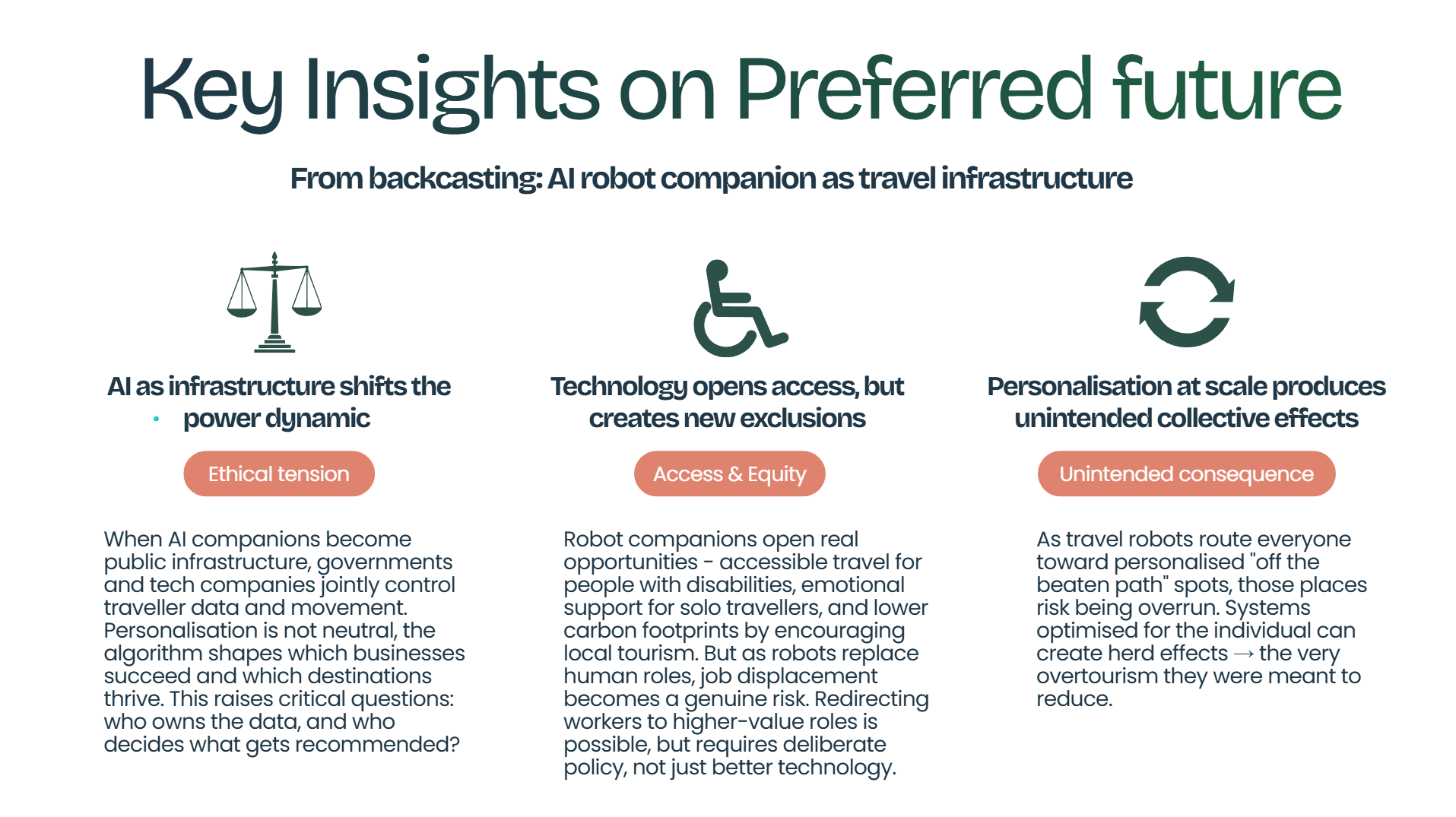
I helped develop the group's Key Insights section, synthesising the team's ideas from our Week 6 backcasting activity into a coherent set of design implications for tourism.
Conceptual Design — A2.G2
I proposed the FamilyRide Shuttle — an autonomous tourist transport concept designed to help families navigate unfamiliar cities without the stress of public transit or ride-hailing.

Refined Prototype — A2.G3
I led ideation for the dietary travel chatbot concept and wrote the Design Challenges section (30% of the group mark), applying HCD analytical lenses to identify three critical challenges: cross-contamination gaps in the knowledge base, passive acceptance of health-critical recommendations, and lack of uncertainty signalling.
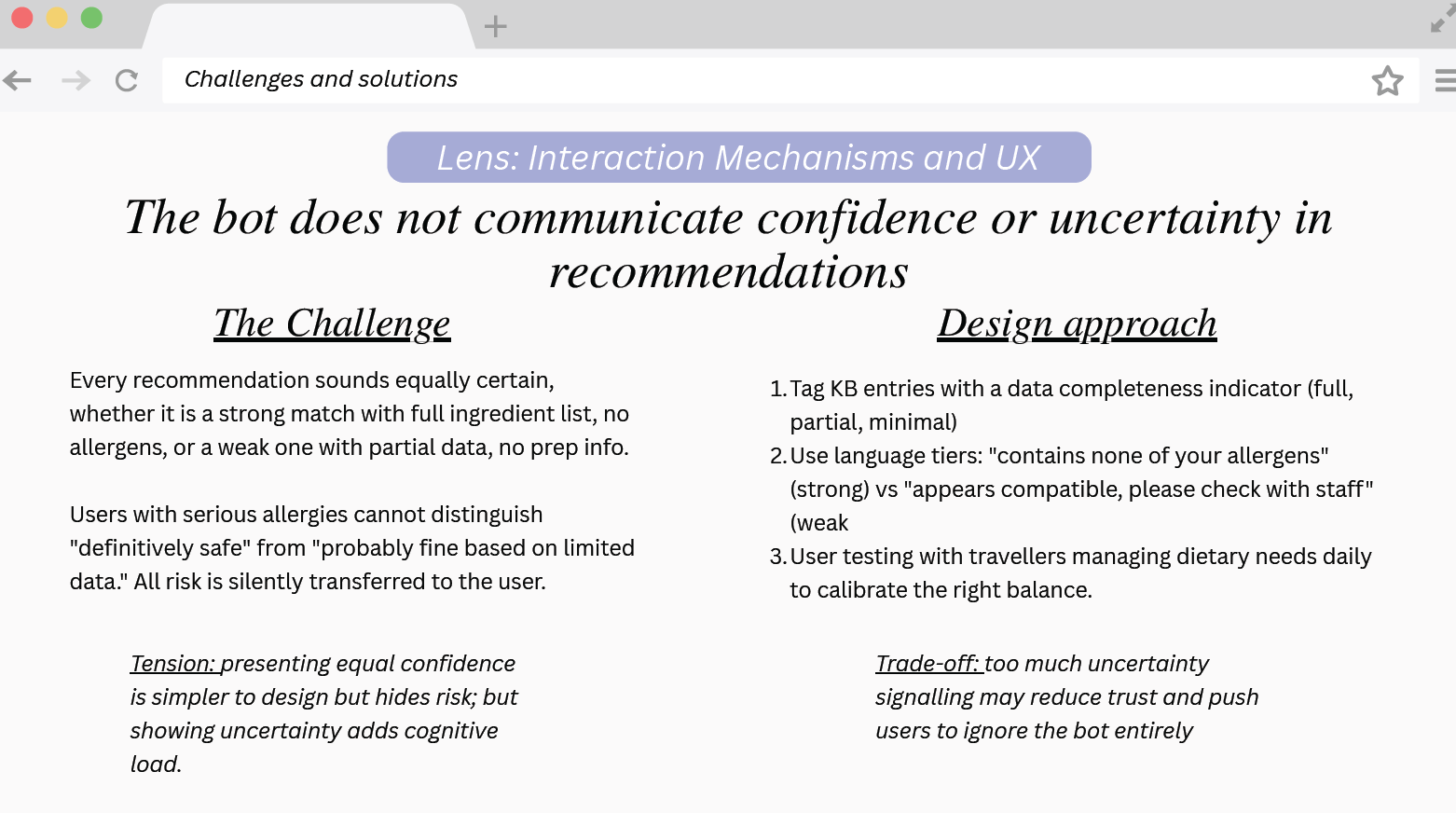
Writing the Design Challenges section required me to move beyond describing the chatbot and actually interrogate it — to ask what happens when a traveller with a severe allergy acts on a recommendation drawn from a static, unverified database, and what responsible design looks like when the stakes are genuinely health-related.
03 — AI in the process
Use (and limits) of AI in design work.
I used Claude at two points across A2. During G1, I used it to help organise and word the Key Insights section based on ideas our group had developed together in the backcasting activity — the thinking was ours, Claude helped make the structure clearer. Later, I used it while working on my Design Challenges analysis to test whether my reasoning was logically sound and to proofread the final writing before submission.
Where it helped
Claude was most useful as a thinking partner for work where I already had the substance.
- Organising and wording the Key Insights section from our backcasting activity (G1)
- Testing the logical structure of my Design Challenges arguments (G3)
- Proofreading and tightening written analysis before submission
Where it didn't
AI has real limits in design work — and this project made several of them visible.
- It can't feel emerging signals. Futures thinking depends on weak signals that haven't been written about yet
- It doesn't experience lived reality. It can simulate empathy through pattern-matching, but that's not the same as understanding what it feels like to be lost in an unfamiliar city with a severe allergy
- It flattens diversity. Without being explicitly pushed, AI defaults toward WEIRD populations (Western, Educated, Industrialised, Rich, Democratic) — a real problem when designing for international travellers
- It can't do genuine speculation. It extrapolates from what already exists — it doesn't imagine. True futures thinking requires creative leaps that break from prior patterns
- It produces things that look finished too fast. Polished-sounding outputs can short-circuit the messy generative phase where the best ideas actually come from
The experience made me more deliberate about when to reach for AI tools. They genuinely helped me communicate ideas I'd already formed — but the most important work in this project, identifying that a "Halal" dish might still be cooked in the same oils and surfaces as non-halal food items, or that an authoritative bot tone silently transfers risk to the user, couldn't be outsourced. That thinking had to come first.
04 — A reflection
What I learned.
Coming into this semester I thought of UX design as being primarily about interfaces — screens, layouts, flows. A2 changed that. The Futures Thinking phase in particular pushed me to think at a different scale: not "what should this button do" but "what kind of world is this product assuming, and is that a world we want?" That kind of speculative, critical framing is something I want to carry into every project I work on.
The Design Challenges work was where I grew most technically. Applying the HCD analytical lenses forced me to sit with the failures in our own design — to name them clearly rather than gloss over them. Identifying that our bot's confident tone was an ethical problem, not just a UX preference, felt like a meaningful shift in how I think about what designers are responsible for. I want to keep developing that kind of critical analysis as a core skill, not just something I do when a brief asks for it.
I also learned that I'm more comfortable leading ideation than I expected. Proposing the chatbot direction and shaping what the group built was a different kind of contribution to the ones I'm used to making, and it showed me that design leadership — getting a group to commit to a direction and move — is a skill in itself. That's something I want to keep building, alongside the more technical prototyping skills I still want to develop in tools like Voiceflow.
05 — Looking ahead
My future as a UX designer.
I want to work on products that help people navigate complex or uncertain situations — and tourism turned out to be a richer design context for that than I expected. Designing for a traveller with a severe allergy in an unfamiliar country meant designing for someone disoriented, time-pressured, unable to read local menus, and trusting a tool with decisions that affect their health. That's a real design responsibility, and working through it — even at prototype scale — made me take it seriously in a way that abstract principles hadn't.
Going forward I want to keep developing the analytical side of UX: getting better at identifying where a system silently makes ethical choices, and naming that clearly in the design process rather than after. I'd also like to build more hands-on conversational design skills. Working at the edge of that medium this semester — a chatbot with no screen, no affordances, and no room for ambiguity — made me realise how much there is still to learn there.
— On AI tool use in this case study
Claude was used to assist in structuring and coding this portfolio page, as well as proofreading my writitng.All written reflections and analysis on this page are my own.